
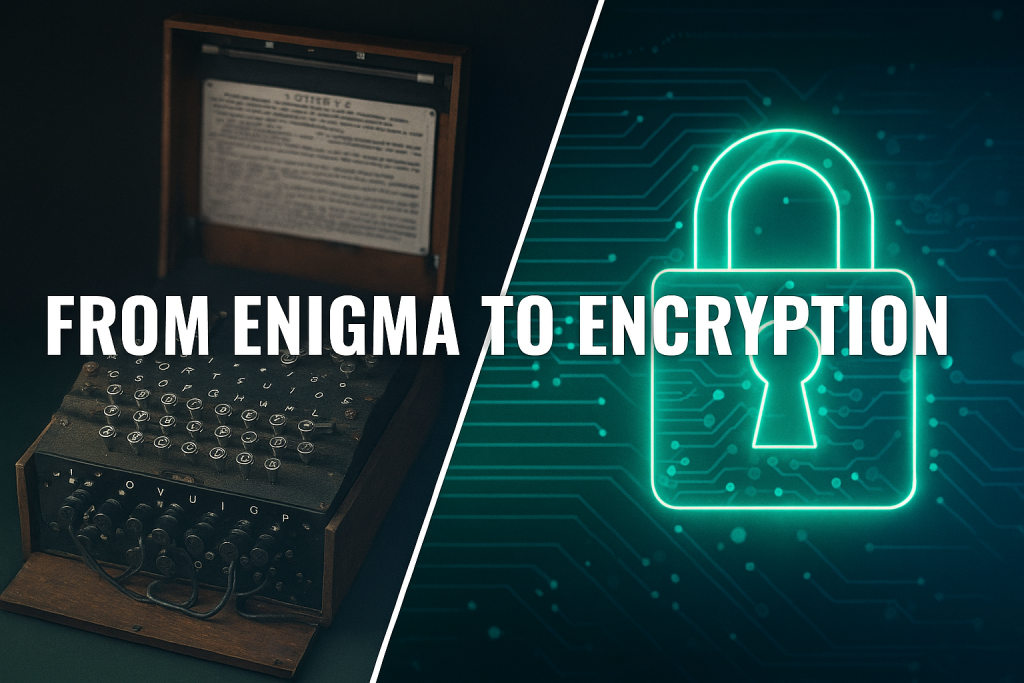
It’s been a while since I last posted here, we’ve been busy developing a few other bits and pieces behind the scenes. Along the way, I stumbled across a problem that got me thinking about maths and how, no matter what else is going on, it just works. As I was working on encryption and one-off codes, that train of thought quickly led me to Alan Turing.
I thought I’d share how fascinating (and forgive me if there are a few rough edges) encryption and decryption really is. What fascinates me even more is that even without the technology we take for granted today, cryptographers in Europe managed to create and then dismantle systems that were supposed to be unbreakable. The story of Enigma is a reminder that the limits of security often have less to do with machines and more to do with the people using them.
During WWII, the German Enigma machine was considered unbreakable. What cracked it wasn’t brute force, but human predictability. German operators often ended messages with *“Heil Hitler”* or sent weather reports in fixed formats. These predictable fragments, called cribs, gave the Allies a foothold.
Alan Turing and Gordon Welchman’s Bombe machine automated the process of testing these cribs against Enigma’s wiring. Two key insights made it possible:
1. No self‑encryption - Enigma could never map a letter to itself.
2. Consistency of repeats - if a letter appeared twice in the crib, it had to encrypt consistently.
These rules collapsed an astronomical search space into something solvable in hours. The brilliance wasn’t just the maths, it was recognising that humans, not machines, were the weak point.
Fast-forward 80 years. Our encryption is mathematically bulletproof - AES‑256, TLS, Signal’s double ratchet. Yet breaches still happen daily. Why? The same reason Enigma fell, humans don’t change.
| Enigma Era (1940s) | Modern Cybersecurity | Weakness |
|---|---|---|
| Predictable sign‑offs (Heil Hitler) | Weak/reused passwords | Predictable behaviour |
| Fixed weather reports | Metadata patterns (who talks to whom, when) | Routine leaks info |
| Repeated message keys | Clicking phishing links | Laziness / shortcuts |
| Ignoring orders to vary phrasing | Ignoring security training | Discipline failures |
| Bombe exploited operator habits | Hackers exploit human error (88% of breaches) | Humans as the soft target |
If the Bombe was the Allies’ way of exploiting human weakness, modern security architects try to design systems that don’t rely on humans doing the right thing. Examples include:
These are all attempts to “Turing‑proof” modern systems, to build resilience against the one factor that hasn’t evolved, yes you've guessed it, us!
From Enigma to end-to-end encryption, the maths has only gotten stronger. But the story hasn’t changed, the weakest link is still the human being at the keyboard, the radio set or the inbox.
Turing’s real lesson wasn’t just about rotors and cribs. It was about the inevitability of human error and the genius of designing systems that account for it. Until we can re-engineer human nature, the best defence is to assume we’ll keep making the same mistakes, we can then build our machines to forgive us for them.

A skilled developer, master coder and troubleshooting wizard, this tech powerhouse is the go-to senior support desk hero, always ready to untangle the most perplexing issues. Favourite quote "Into the dark we go softly...""...armed with obsidian protocols and blackbox ciphers". Inspired by Dylan Thomas (the first bit not the last bit)